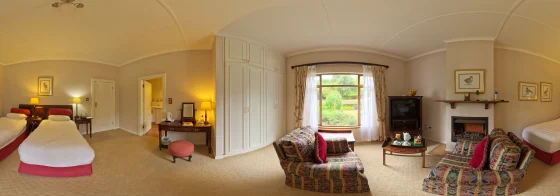
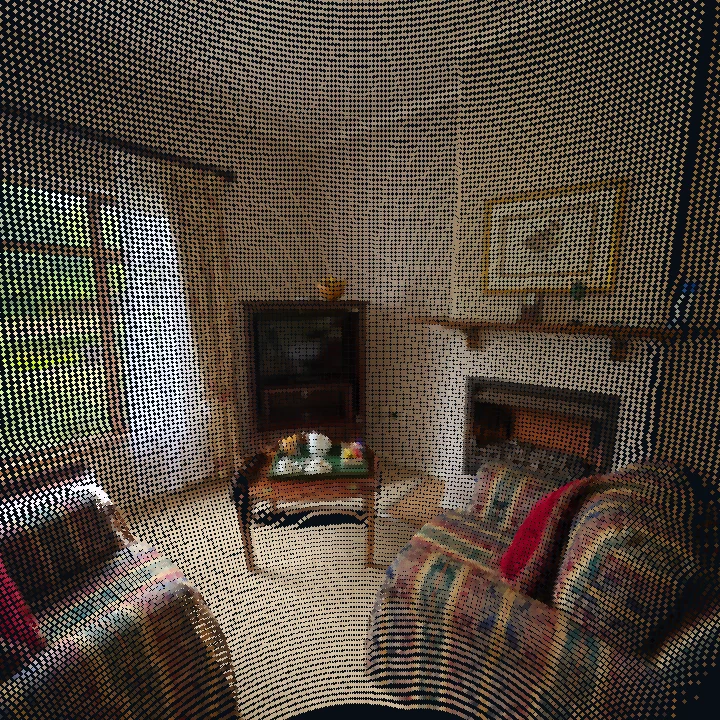
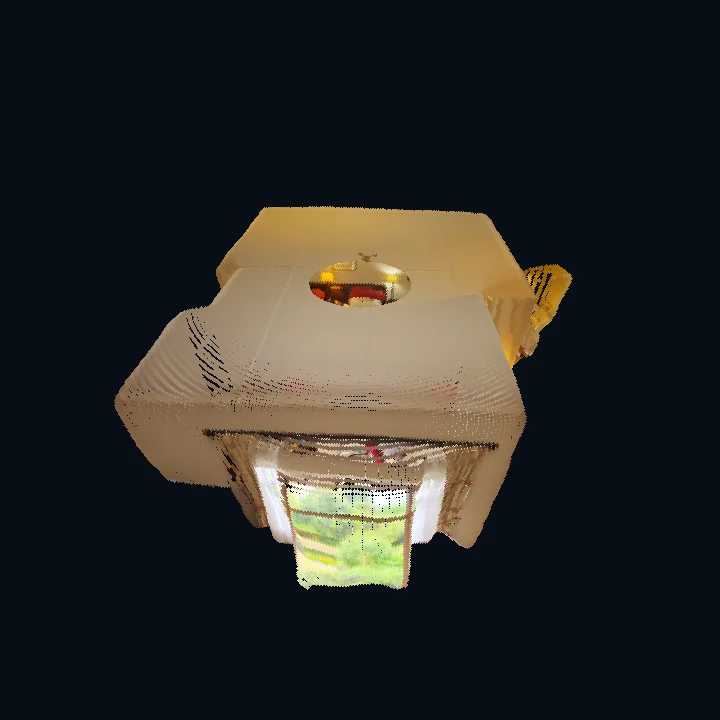

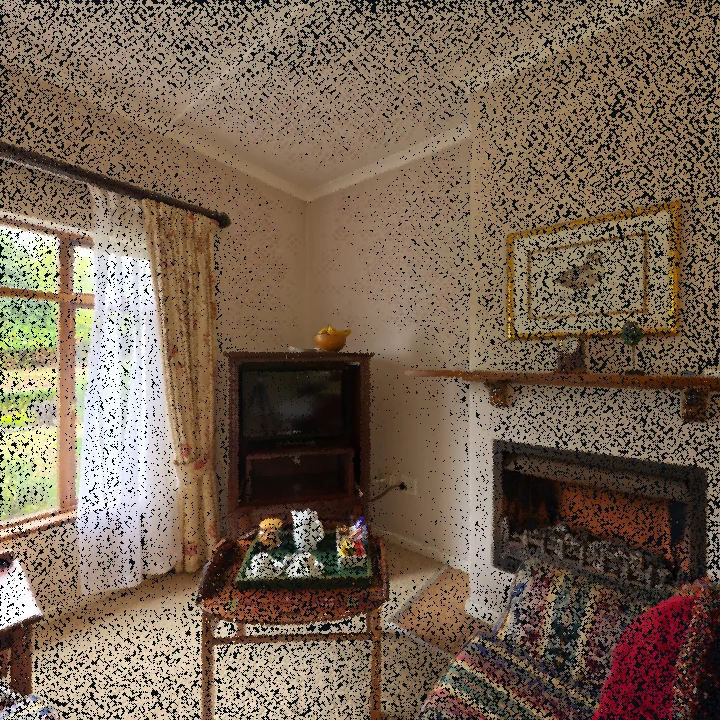
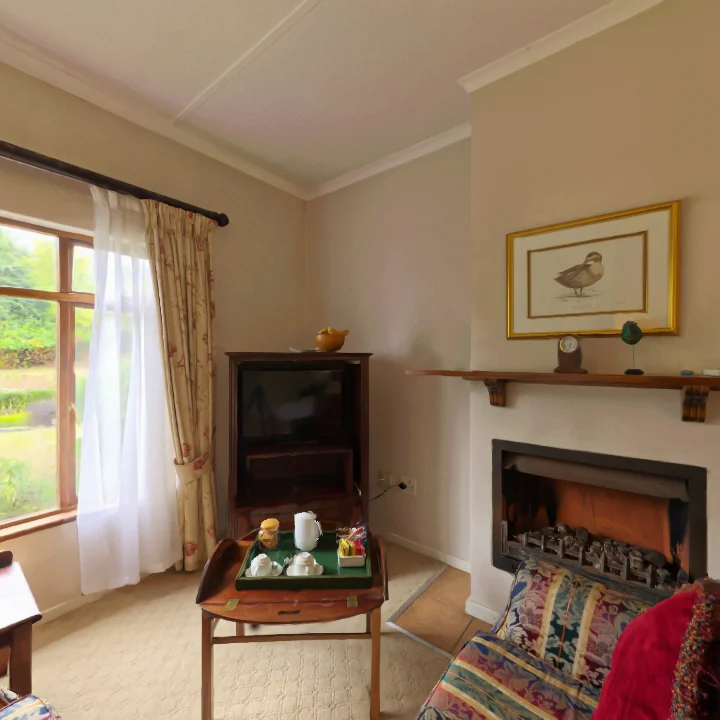
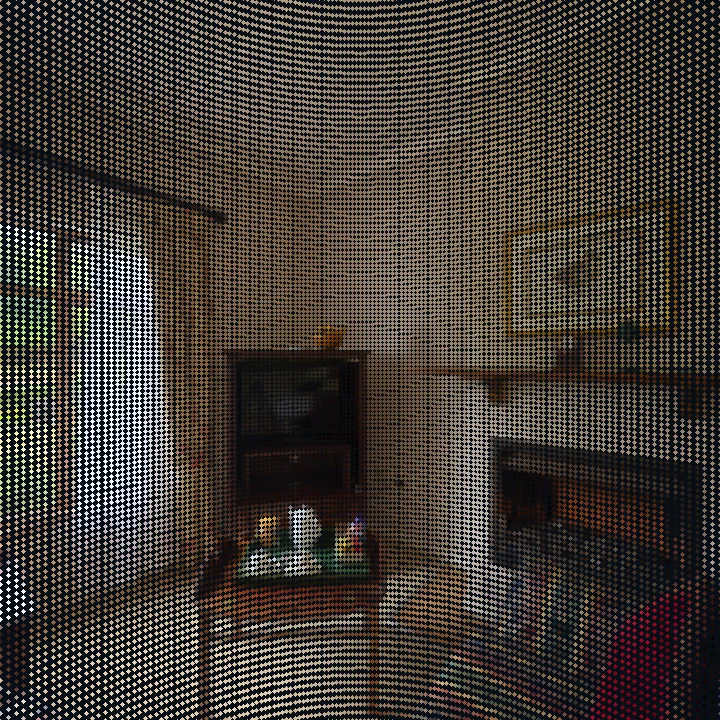
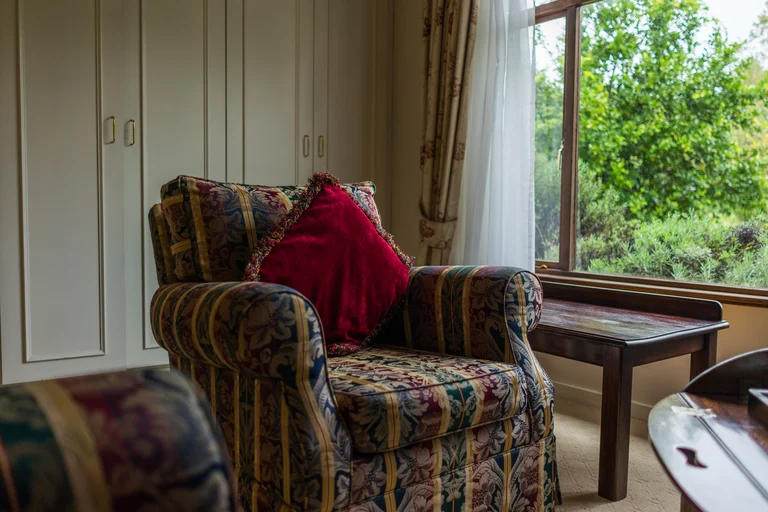
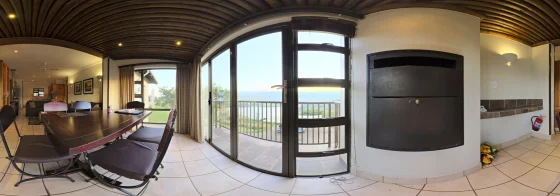
Switching to centers outside the supported view exposed missing coverage.
Return inside before changing representation; compare the same camera.
The transition held together. Exterior coverage limits stayed disclosed.
VISTAlabs / SPATIAL AUTHENTICATION
Metric 3D understanding for physical-space authentication. Built to explore whether a place itself can become an authentication signal.
Astra-assisted research01 / THE MODEL
Explore what a scene contains, then how it becomes a reconstruction.

Cropped equirectangular input · aligned with depth and normalsLYTHWOOD
RGB, depth and normals share a pixel grid. Points and 3D use the source-facing perspective view. Normals are derived; Gaussian reconstruction is downstream.
02 / FROM OBSERVATIONS TO GEOMETRY
Drag through a real 180° camera orbit around the reconstructed room. No flat-image animation.

109,760 native VISTA pointsPre-rendered views · actual saved cameras
Loading panorama controls…
03 / METRIC UNDERSTANDING
The model estimates physical scale. These endpoint distances come from retained geometry, not a tape measure.
The frustum shows a virtual source view. It is not a physical camera baseline. Incomplete unseen and polar coverage remains visible.


04 / POINTS TO PHOTOREALISTIC 3D
VISTA supplies model-derived scene geometry. Downstream InfinitySplat uses RGB and depth prompts to build a Gaussian scene.


Compare structure and appearance at exactly the same saved camera.
Centers are a 240,000-point visualization of learned primitives. The final render uses all 1.5 million Gaussians. No inferred geometry is hidden behind an accuracy claim.
05 / A SEPARATE SINGLE-IMAGE PATH
The RGB-only InfinitySplat branch starts with one perspective photograph. Its own DepthPro depth becomes points, learned centers and a rendered Gaussian scene.
This branch does not consume VISTA depth. Novel views are restricted to the supported camera path; unseen surfaces are not validated.

06 / THREE REAL INTERIORS

Soft light. Fine structure.
1.5M Gaussians per image07 / RESULTS & SCOPE
Our goal is repeatable physical-place verification. Here is what the current demonstrations show, and what still needs evaluation.
Model-scaled depth from panorama inputs. Independent physical-scale accuracy is not established by these demonstrations.
Retained camera transforms and virtual source-view frustums. They are not an independently surveyed camera baseline.
Organized points and matched saved cameras connect the displayed representations of each scene.
A research objective across recaptures, devices and viewpoints. This release does not supply a validated multi-session benchmark.
The key requirement for persistent spatial signatures. Re-rendering one capture is not evidence of repeatability across captures.
The intended downstream task. No released matcher, authentication score or security decision runs in these demonstrations.
Three reviewed indoor demonstrations establish presentation scope. Cross-session consistency, spatial error and authentication performance require separate validation. No unverified accuracy percentage is published. Read the results and evaluation scope ↗
08 / THE DATA PROBLEM
Physical-place verification needs the same environment across cameras, sessions and object changes. We built Blender- and Unreal-based tooling for controlled metric supervision and targeted experiments.
Known geometry. Positive pairs. Hard negatives. The data engine lets us ask what stays identifiable when the observation changes.
Inside the research program ↗Private training data and its generation recipe are not shown. The grid uses public demonstration scenes to illustrate supervision channels; it is not a sample of the private corpus.
LYTHWOOD
CAYLEY
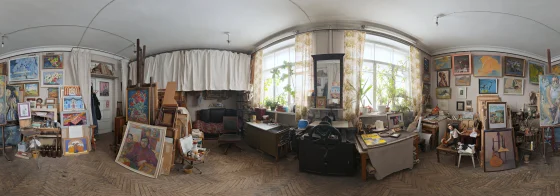
WORKSHOPPublic demonstration scenes · private training data not shown
09 / BUILT WITH GPT-6 ASTRA
Pre-Astra assistants helped build Blender / Unreal generation infrastructure. Astra helped us reason through dataset and geometry failures, refine simulation distributions, design experiments and evaluation, and plan smaller models.
Switching to centers outside the supported view exposed missing coverage.
Return inside before changing representation; compare the same camera.
The transition held together. Exterior coverage limits stayed disclosed.
The controlled comparison had mixed numerical and visual results.
Hold camera and renderer settings fixed; inspect fine detail alongside error metrics.
768 was selected for visible detail, without a universal accuracy claim.
Frame collection stopped partway through the camera path.
Use bounded resumable captures, per-frame checks and immutable camera receipts.
The complete sequence was recovered and verified.
Model scale can look convincing without independent ground truth.
Keep endpoint provenance, distinguish virtual frustums, and audit every claim.
Model-derived distances are shown with accuracy explicitly unverified.
10 / WHY WE BUILT THIS
Something you know
Something you have
Something you are
Somewhere you truly are?
That question demands reconstruction that stays consistent across cameras, sessions, lighting and scene changes.
11 / SPATIAL AUTHENTICATION / RESEARCH DIRECTION
Enroll a room. Build a private spatial template. Compare a later reconstruction. Investigate whether the same physical place can be recognized.
ENROLLED ROOM
NEW CAPTURE / CONCEPTThe hypothesis: stable geometry could support a same-place comparison across viewpoints. No matcher is running in this illustration.
Pre-recorded illustrations only. No camera access, biometric enrollment, replay detection or live authentication takes place.
12 / BEYOND PASSWORDS
We are a biometrics-focused team exploring palm recognition, spatial authentication and privacy-preserving identity systems—built for consumer-friendly hardware and software.
Research path: data engine → metric reconstruction → evaluate repeatable geometry → spatial template → same-place / different-place verification → smaller consumer models.
13 / EARLY ACCESS
Join the early research list for spatial authentication, metric reconstruction, model access and biometric research.
14 / THE LAUNCH FILM
80 seconds · original ambient scoreDownload film ↗
15 / EXPLORE THE RESEARCH